


Page 56 - GUIAS ESC ESH 2018
P. 56
56                                                                                     ESC/ESH Guidelines


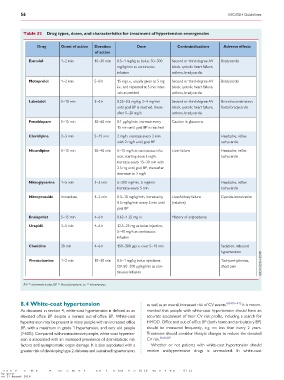
           Table 32  Drug types, doses, and characteristics for treatment of hypertension emergencies


                 Drug      Onset of action  Duration      Dose             Contraindications   Adverse effects
                                         of action

             Esmolol       1–2 min       10–30 min  0.5–1 mg/kg as bolus; 50–300  Second or third-degree AV  Bradycardia
                                                  mg/kg/min as continuous  block, systolic heart failure,
                                                  infusion               asthma, bradycardia

             Metoprolol    1–2 min       5–8 h    15 mg i.v., usually given as 5 mg  Second or third-degree AV  Bradycardia
                                                  i.v., and repeated at 5 min inter-  block, systolic heart failure,
                                                  vals as needed         asthma, bradycardia
             Labetalol     5–10 min      3–6 h    0.25–0.5 mg/kg; 2–4 mg/min  Second or third-degree AV  Bronchoconstriction,
                                                  until goal BP is reached, there-  block; systolic heart failure,  foetal bradycardia
                                                  after 5–20 mg/h        asthma, bradycardia
             Fenoldopam    5–15 min      30–60 min  0.1 mg/kg/min, increase every  Caution in glaucoma
                                                  15 min until goal BP is reached
             Clevidipine   2–3 min       5–15 min  2 mg/h, increase every 2 min               Headache, reflex
                                                  with 2 mg/h until goal BP                   tachycardia
             Nicardipine   5–15 min      30–40 min  5–15 mg/h as continuous infu-  Liver failure  Headache, reflex
                                                  sion, starting dose 5 mg/h,                 tachycardia
                                                  increase every 15–30 min with
                                                  2.5 mg until goal BP, thereafter
                                                  decrease to 3 mg/h
             Nitroglycerine  1–5 min     3–5 min  5–200 mg/min, 5 mg/min                      Headache, reflex
                                                  increase every 5 min                        tachycardia
             Nitroprusside  Immediate    1–2 min  0.3–10 mg/kg/min, increase by  Liver/kidney failure  Cyanide intoxication
                                                  0.5 mg/kg/min every 5 min until  (relative)
                                                  goal BP
             Enalaprilat   5–15 min      4–6 h    0.62–1.25 mg i.v.      History of angioedema

             Urapidil      3–5 min       4–6 h    12.5–25 mg as bolus injection;
                                                  5–40 mg/h as continuous
                                                  infusion
             Clonidine     30 min        4–6 h    150–300 mg i.v. over 5–10 min               Sedation, rebound
                                                                                              hypertension

             Phentolamine  1–2 min       10–30 min  0.5–1 mg/kg bolus injections              Tachyarrhythmias,
                                                  OR 50–300 mg/kg/min as con-                 chest pain
                                                  tinuous infusion

           AV = atrioventricular; BP = blood pressure; i.v. = intravenous.


                                                            .
          8.4 White-coat hypertension                       . . .  as well as an overall increased risk of CV events. 68,410–412  It is recom-
          As discussed in section 4, white-coat hypertension is defined as an  . . .  mended that people with white-coat hypertension should have an
          elevated office BP despite a normal out-of-office BP. White-coat  . . .  accurate assessment of their CV risk profile, including a search for
          hypertension may be present in many people with an increased office  . . .  HMOD. Office and out-of-office BP (both home and ambulatory BP)
          BP, with a maximum in grade 1 hypertension, and very old people  . . .  should be measured frequently, e.g. no less than every 2 years.
          (>50%). Compared with normotensive people, white-coat hyperten-  . . . .  Treatment should consider lifestyle changes to reduce the elevated
          sion is associated with an increased prevalence of dysmetabolic risk  . . .  CV risk. 85,86,89
          factors and asymptomatic organ damage. It is also associated with a  . . .  Whether or not patients with white-coat hypertension should
          greater risk of developing type 2 diabetes and sustained hypertension,  . .  receive antihypertensive drugs is unresolved. In white-coat


  Downloaded from https://academic.oup.com/eurheartj/advance-article-abstract/doi/10.1093/eurheartj/ehy339/5079119
  by guest
  on 27 August 2018

